Lead institution: Brookhaven National Laboratory
C2QA aims to overcome the limitations of today’s noise intermediate scale quantum computer systems to achieve quantum advantage for scientific computations in high-energy, nuclear, chemical and condensed matter physics. The integrated five-year goal of C2QA is to deliver a factor-of-10 improvement in each of software optimization, underlying materials and device properties, and quantum error correction, and to ensure these improvements combine to provide a factor of 1,000 improvement in appropriate computation metrics.
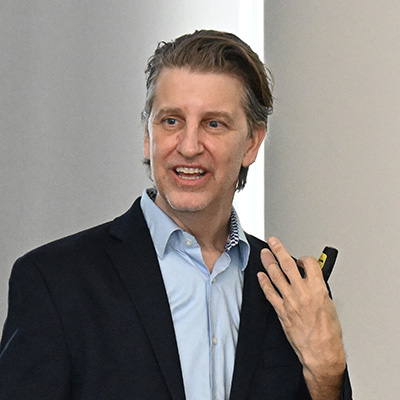
Chuck Black
C2QA Director
Deputy Associate Laboratory Director, Brookhaven National Laboratory

Kai-Mei Fu
C2QA Deputy Director
Professor of Physics and Electrical Engineering, University of Washington

Steven Hulbert
C2QA Deputy Director
Electronic Structure Techniques Program Manager, Brookhaven National Laboratory
Lead institution: Argonne National Laboratory
Q-NEXT brings together world-class researchers from national laboratories, universities and technology companies with the goal of developing the science and technology to control and distribute quantum information. Q-NEXT develops networks of sensors and secure communications systems, creates materials for scalable quantum devices, and trains the next-generation quantum-ready workforce to ensure continued U.S. scientific and economic leadership in the rapidly advancing field of quantum information science.


Jennifer Dionne
Q-NEXT Deputy Director
Senior Associate Vice Provost of Shared Research Platforms/Shared Facilities, Stanford University

Lead institution: Lawrence Berkeley National Laboratory
QSA catalyzes national leadership in quantum information science to co-design the algorithms, quantum devices, and engineering solutions needed to deliver certified quantum advantage in scientific applications. QSA brings together dozens of scientists who are pioneers of many of today’s unique quantum engineering and fabrication capabilities.


Chris deRose
QSA Deputy Director
R&D Manager Photonic Microsystem Technology, Sandia National Laboratories

Lead institution: Oak Ridge National Laboratory
QSC researchers are working to establish the nation’s first fault-tolerant ecosystem for hybrid quantum high-performance computing (QHPC). By integrating hybrid algorithms, scientific applications, QHPC architectures, and experimental validation with leadership-class HPC, QSC researchers are building the foundations for scalable, error-resilient quantum technologies. Through strong partnerships with industry and a commitment to developing the next generation of scientists and engineers, the QSC is accelerating the transition of quantum innovation from the laboratory to real-world applications – advancing secure, energy-efficient computing and reinforcing U.S. leadership in quantum science.


Lead institution: Fermi National Accelerator Laboratory
The primary mission of SQMS is to achieve transformational advances in the major crosscutting challenge of understanding and eliminating the decoherence mechanisms in superconducting 2D and 3D devices, with the goal of enabling the construction and deployment of superior quantum systems for computing and sensing. In addition to the scientific advances, SQMS will target tangible deliverables in the form of unique foundry capabilities and quantum testbeds for materials, physics, algorithms, and simulations that could broadly serve the national QIS ecosystem.